

Special Education Policy
School: SCOIL THOMAIS
Glossary
- SEN Special Education Needs
- SET Special Education Teacher
- SNA Special Needs Assistant
- DES Department of Education & Skills
- NCSE National Council for Special Education
- NEPS National Educational Psychological Service
- SENO Special Education Needs Organiser
- SSP School Support Plan
- BIAP Belfield Infant Assessment Profile
- MIST Middle Infants Standardised Test
- DTEL Drumcondra Test of Early Literacy
- DTEN Drumcondra Test of Early Numeracy
- NNRIT New Non-Reading Intelligence Test
- NVRT Non Verbal Reasoning Test
- YARC York Assessment of Reading Comprehension
Introductory Statement
Our SEN policy was coordinated by the Special Education Team, in consultation with staff in 2019. The development of our SEN policy was identified as one of our priorities during a whole school development planning day in June 2017. This policy is drawn up in accordance with Circular No 0013/2017.
Rationale
The purpose of this policy is to:
- provide practical guidance to staff, parents and other interested parties about our SEN procedures and practices.
- outline the framework for addressing additional needs in our
- comply with legislation (Education Act 1998, Equal Status Act, 2000, fulfil DES circular 0013/17 Circular to the Management Authorities of all Mainstream Primary Schools; Special Education Teaching Allocation, and new 2017 Guidelines for Primary Schools: Supporting Pupils with Special Educational Needs in Mainstream Schools).
Aims of the Policy
Scoil Thomáis is committed to helping all our pupils to achieve their full potential. The provision of a quality system of SEN support teaching is integral to this commitment.
Through the implementation of our SEN policy we aim to:
- support the inclusion of children with SEN in our school
- develop positive attitudes about school and learning in our pupils
- ensure that the Staged Approach/Continuum of Support is implemented
- optimise the teaching and learning process in order to enable pupils with learning difficulties to achieve adequate levels of proficiency in literacy and numeracy before leaving primary school (Guidelines for Schools, p15)
- enable pupils to participate in the full curriculum
- support appropriate differentiation in the classroom
- support pupils’ development both socially and emotionally
- enable pupils to understand themselves as learners
- involve parents in supporting their children
- promote collaboration among teachers in the implementation of whole-school policies on special education for our pupils
Specifically, this policy aims to outline our procedures and practices of how
- we identify special educational needs in our pupils
- allocate resources to effectively meet the needs of pupils with special educational needs
- divide the roles and responsibilities among our school community in relation to pupils with special educational needs
- track, monitor, review and report on the progress of pupils with special educational needs
- communicate information between the SET team, principal, staff and parents/guardians
Principles of SEN Support
The provision of SEN support in Scoil Thomáis is guided by the following principles:
- Quality of teaching
- Effective whole-school policies
- Direction of resources towards children in greatest need
- Implementation of a staged approach to support provision at Class Support/School Support/School Support Plus levels.
- Provision of the model(s) of intervention appropriate for the child, including the withdrawal model, in-class support model, individual or group work, etc.
Enrolment
Scoil Thomáis aims to meet the needs of any child whom the parent wishes to register at the school as long as a place is available and the admission criteria are fulfilled. The Education For Persons with Disabilities Act 2004 states that ‘A child is entitled to attend the school which is most suited to his or her overall needs’.
No child will be refused admission solely on the grounds that s/he has SEN except where the provision required is incompatible with that available in our school.
Identifying Pupils with Special Educational Needs – Continuum of Support
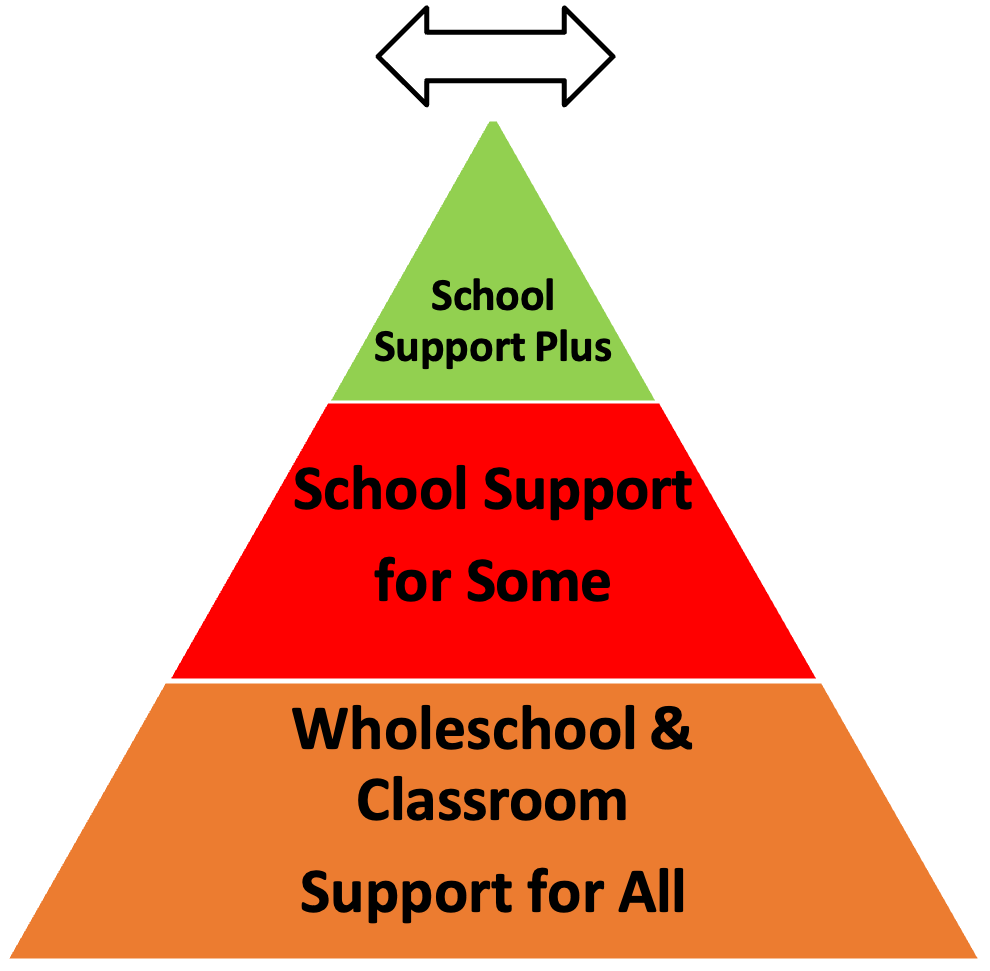
We use the Continuum of Support Framework set out by the Department of Education to identify and support children with SEN. We recognise that special educational needs occur along a continuum, ranging from mild to severe, and from transient to long-term and that pupils require different levels of support depending on their identified additional needs. By using this framework, it helps us implement a staged approach to ensure that our support and interventions are incremental, moving from class based interventions to more intensive and individualised support, and are informed by careful monitoring of progress.
The Continuum of Support is a problem-solving model of assessment and intervention that enables us to gather and analyse data, as well as to plan and review the progress of individual pupils.
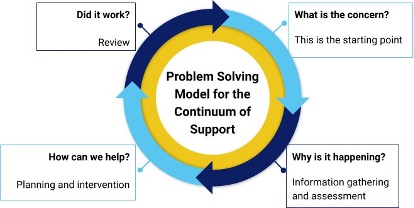
Identification of educational needs is central to Scoil Thomáis’ SEN policy and the new allocation model. By using the Continuum of Support framework, we can identify pupils’ educational needs, to include academic, social and emotional needs, as well as needs associated with physical, sensory, language and communication difficulties. This, in turn, allows us to identify and respond to needs in a flexible way.
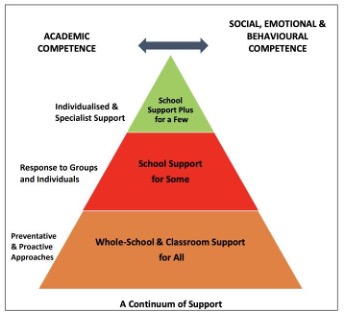
Stage 1: Classroom Support
Classroom Support is the most common, and typically the first response to emerging needs. It is a response for pupils who have distinct or individual educational needs and who require approaches to learning and/or behaviour which are additional to or different from those required by other pupils in their class. Problem-solving at this level typically begins when a parent or teacher has concerns about an individual pupil. The class teacher and parents, with support from the SET when necessary, discuss the nature of the problem and consider strategies which may be effective. Classroom Support incorporates the simple, informal problem-solving approaches commonly used by class teachers to support emerging needs.

Stage 2: School Support
In some cases, interventions at classroom support level are not enough to fully meet the pupil’s special educational needs. School Support may, therefore, be required. The class teacher needs
to involve the Special Education Team in the problem solving process at this point and it involves more systematic gathering of information and the development and monitoring of a School Support Plan.
Stage 3: School Support Plus
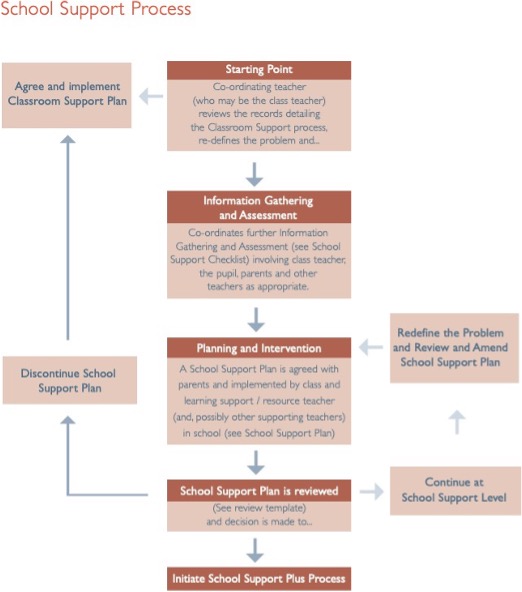
If a pupil’s additional educational needs are severe and/or persistent, they are likely to need intensive support. School Support Plus will generally involve personnel outside the school team in the problem solving, assessment and intervention process. However, the information from Classroom and School Support work will provide the starting point for problem-solving at this level. The flow diagrams below outline how we gather information to identify needs and support children with additional needs.

A more comprehensive explanation of each stage can be found in the Continuum of Support – Guidelines for Teachers
https://www.education.ie/en/Schools-Colleges/Services/National-Educational-Psychological-Service-NEPS-/neps_special_needs_guidelines.pdf
Order of Priority in which additional supports are allocated:
Cognisant of the principles outlined in DES Circular 0013/2017 and the accompanying guidelines, Scoil Thomáis will allocate support as follows:
- Pupils who formerly had an allocation of Low Incidence Teaching Hours (LITH). No pupils will fall into this category after June 2023.
- Pupils who present with a high level of complex needs
- Early intervention in
- English Language support for EAL pupils in Junior and Senior Infants
- Pupils struggling with Literacy in Senior Infants to 4th Class (13th percentile or under)
- In-class support/team teaching for Numeracy in 1st to 3rd Classes
- Pupils struggling with Numeracy in 4th Class (13th percentile or under)
Student Support File: Recording and Tracking School Support Plans
Provision for pupils with special educational needs is enhanced through clear identification processes and careful planning of interventions to address academic and/or personal and social development needs. Identification of needs, planning, target-setting and monitoring of outcomes are essential elements of an integrated and collaborative problem-solving process.
The Special Education Support Cycle which operates in Scoil Thomáis is illustrated in the figure below.
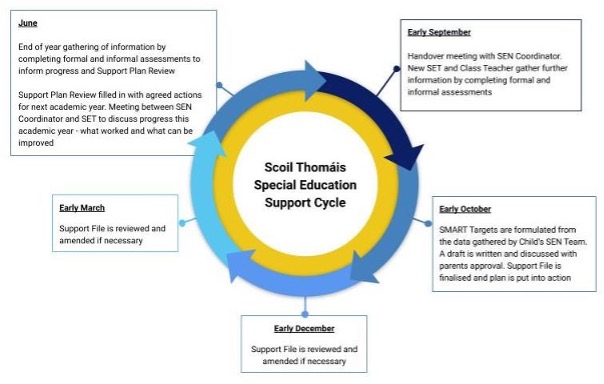
A Student Support File Template (available at Appendix 1 in this policy) is opened for every pupil who enters any level of the Continuum of Support while enrolled in Scoil Thomáis. This file is a tool to record and track a pupil’s pathway through the Continuum of Support. The Student Support File facilitates teachers in documenting progress and needs over time and assists them in providing an appropriate level of support to pupils in line with their level of need. Following a period of intervention and review of progress, a decision is made as to the appropriate level of support required by the pupil. This may result in a decision to discontinue support, to continue the same level of support, or move to a higher or lower level of support. As special educational needs can vary from mild to transient to significant and enduring, educational planning reflects the level of need of the individual pupil. In this regard, the Student Support File facilitates a graduated response across the different levels of the Continuum: Classroom Support, School Support and School Support Plus.
In Scoil Thomáis, there are two copies of the Student Support File kept on record. One is kept in a purple SEN folder which is kept by the Class Teacher and regularly updated by both the Class Teacher and the SET. The other copy of the Student Support File is kept by the SEN Coordinator.
Student Support Plans (SSP)
Based on Psychologists Report, standardised and informal tests, record of differentiation, the class teacher together with the SET, SNA (if assigned), parents and representatives of outside agencies (if necessary) formulate an SSP. These plans, which employ a small steps approach, feature significantly in the provision that we make for pupils with SEN in Scoil Thomáis. By breaking down the existing levels of attainment into finely graded targets, we ensure that the child experiences success.
This plan includes:
- the nature and degree of the child’s abilities and skills
- the degree of the child’s special needs,
- the present level of performance,
- services to be provided,
- services for transition to 2nd level school where appropriate,
- the goals which the child is to achieve over a period of an instructional term (generally around 12 weeks).
The strategies set out in these plans will, as far as possible, be implemented in the normal classroom setting.
The management of the support plan strategies will be the responsibility of the class teacher, SET and the SEN coordinator.
Review of Student Support Plans
The SEN coordinator will ensure that a review is conducted at the end of each instructional term. The class teacher consults with the SET, the child (and SNA if appointed). They agree on the expected outcomes of the plan. The parents are invited to attend a meeting to discuss or make recommendations to the SSP if they so wish. Again, outside agencies may play a part in formulating the final copy. The review will be recorded on the log of actions and placed in the purple SEN folders in the classroom and in the SEN Coordinator’s office.
Depending on the progress report, children may move to a different level on the continuum of support. The review in June will be part of the plan for the next teacher in September. It will be carried out as outlined above. Plans for children moving to Second Level will be referred to at the consultation meetings with the Second Level representatives.
Roles and Responsibilities to support the Continuum of Support
The role of supporting learning is a collaborative responsibility shared by all: The Board of Management, Senior and Middle Management, SEN Coordinator, Teachers, Special Needs Assistants (SNAs) Parents/Guardians, and pupils. It is important that everyone contributes to the planning and implementation of our SEN Policy.
SEN Teams In Ireland
Special Educational Needs (SEN) Teams were first advocated in Circular 24/03 as well as in Circular 02/05. The most recent NCSE document on the Inclusive Education Framework (2011) promotes the development of SEN Teams. Class Teachers, SEN Teachers, the SEN Co-ordinator, SNAs, and the Principal constitute the school SEN Team and each team member has a clear role in supporting children with special educational needs to access the curriculum. In our school, we view the Class Teacher as central to the educational needs of each pupil with SEN. All other staff members work with the Class Teacher to serve the needs of the child as stated in the Circular 02/05
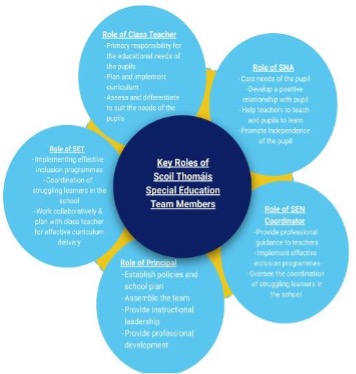
Key Roles of the Scoil Thomáis Special Education Team Members
The Principal
As outlined in the Learning Support Guidelines (2000, P.39) the Principal, in consultation with the Board of Management, has overall responsibility for the school’s SEN programme and for the operation of services for children with Special Educational Needs. The new allocation model states the principal’s leadership role is central.
The Principal:
- Has overall responsibility for SEN in the school.
- Helps Teachers/SNAs to increase their knowledge and skills in the area of Special Educational Needs by encouraging them and providing opportunities for them to avail of relevant professional development.
- Meets regularly with the SEN Coordinator.
- Oversees SEN related policies and procedures.
Board of Management
The Board of Management has an important role in developing, supporting, and monitoring school policy on Special Educational Needs.
The Board of Management:
- Oversees the development, implementation and review of the SEN policy.
- Ensures that adequate classroom accommodation and teaching resources are provided for the SEN Team.
- Ensures a secure facility for storage of records relating to children.
SEN Coordinator
In Scoil Thomáis, the role of the SEN Coordinator has been assigned to the Deputy Principal. The SEN Coordinator:
- Works on the development of the school plan for Special Educational Needs.
- Oversees the implementation of a whole-school assessment and screening programme to identify children with very low achievement and/or learning difficulties so that they can be provided with the support they need.
- Collaborates with the Principal, SEN Team, Class Teachers, SNAs, External Agencies and Parents/Guardians of SEN children.
- Keeps Special Education Teachers, Class Teachers, SNAs, and Parents/Guardians informed about relevant external assessment and Special Educational Needs services that are available.
- Maintains a list of children who are receiving SEN support.
- Helps to coordinate the caseloads/work schedules of the SEN Team.
- Liaises with external agencies such as Psychologists, Family Doctors, Occupational Therapists, Speech and Language Therapists, NEPS, the School Aged Disability Team, and the Special Educational Needs Organiser (SENO) to arrange assessments and special provisions for children with Special Educational Needs.
- Collaborates with SEN Team/Class Teachers in identification, screening, and referral procedures.
- Maintains records and disseminates information to relevant school personnel.
- Orders, purchases, distributes, and informs Staff on class screening materials and procedures.
- Ensures that all documentation relating to children who receive additional support is properly filed and secured.
- Facilitates regular meetings with SEN Team and SNA Team.
Class Teacher
The Class Teacher has primary responsibility for the progress of all children in his/her class including those receiving Special Education.
The Class Teacher:
- Liaises regularly with Parents/Guardians on their children’s progress.
- Facilitates the implementation of various models of support provided by the SEN Team (See Appendix 1 – Support Plan Template).
- Liaises initially with Parents/Guardians to make them aware of the difficulties their child may be experiencing.
- In conjunction with the SEN Team, uses class observations, standardised, screening, and diagnostic test results to highlight children’s required levels of support.
- Collaborates with the SEN Team, SEN Teacher, and SNA on Student Support File.
- Attends Student Support Meetings with Parents/Guardians, SEN Teacher, and SNA.
- Meets with the SEN Team/Teacher on a regular basis to monitor progress and adapt the learning programme as necessary.
- Liaises with the SEN Team/SET in the purchasing of relevant additional support materials.
Special Education Teacher (SET)
SET refers to any teacher employed by the Board of Management in a Special Education Teaching role and includes previously termed Learning Support Teachers, Resource Teachers and EAL Teachers. The SET helps to provide an education which meets the needs and abilities of children assessed as having a specific disability (as outlined in Circular 02/05) and/or children who are experiencing low achievement as documented in standardised and/or diagnostic test results.
SETs should be familiar with a wide range of teaching approaches, methodologies and resources to cater for particular learning styles and to meet a variety of needs. Teaching approaches will include a combination of team-teaching initiatives, co-operative teaching, early intervention and small group or individual support. Depending on the learning needs identified, a pupil with special educational needs may be supported at classroom level, or through mainstream classroom placement with additional teaching delivered through in-class or withdrawal support models.
Some pupils with more complex and enduring needs may require specific methodologies, teaching approaches and/or learning activities. Such interventions should be based on careful identification of strengths and needs, including multi-disciplinary assessment when necessary.
The type of support offered depends on the child’s individual needs and takes the form of:
- curriculum support
- life and/or social skills training
- physical training/gross motor development
- speech training/communication and/or language development
- behaviour modification programmes
- assistance with sensory modulation
- development of anger management strategies
- a combination of some/all of the above
The SET:
- Maintains relevant weekly/fortnightly/monthly planners on children/groups of children in receipt of Special Education Teaching.
- In conjunction with the Class Teacher, implements various in-class models of support as referred to in Appendix 1 – School Support File Template.
- In collaboration with the Class Teacher, gathers information on children to create a profile of children experiencing difficulties (See NEPS Continuum of Support).
- In consultation with the Class Teacher, administers relevant screening and/or diagnostic tests to children who have been identified as experiencing difficulties.
- Liaises with outside agencies (e.g. Psychologists, Occupational Therapists, Speech and Language Therapists) on providing support and input on the teaching of children with Special Educational Needs.
- Develops a Student Support File to address the needs of children experiencing low achievement as reported in relevant standardised and/or diagnostic test results. The SET agrees the specific targets with the Class Teacher and Parents/Guardians for children and/or group of children.
Special Needs Assistant (SNA)
The role of the SNA is to provide schools with additional support in assisting children with Special Educational Needs who also have additional and significant care needs (Circular 07/02, Circular 0030/2014). Applications for SNA are based on recommendations from the professional who assessed the child and who diagnosed the child’s special educational needs. The Special Educational Needs Organiser (SENO) is responsible for SNA allocation.
Parents/Guardians
Collaboration and sharing of relevant information between home and school are essential elements of our SEN policy. Parents/Guardians through their unique knowledge of their own children have much to contribute to their child’s learning.
The Parents/Guardians should:
- share any information, reports or reports pending from health professionals, and/or concerns regarding their child’s development.
- provide copies of professional reports to the school when their child has been offered a place.
- support the work of the school and keep the class teacher informed of the progress and challenges they observe in their child’s learning.
- attend meetings arranged by the class teacher or SET team.
- support the targets outlined in their child’s support plans and engage in all suggested home-based activities wherever possible.
- inform the post-primary school of their child’s needs, at the transition stage.
Pupils
Pupils who are in receipt of supplementary teaching should, as appropriate:
- be given the opportunity to contribute to the setting of the medium and short-term learning targets.
- become familiar with the targets that have been set for them.
- develop ‘ownership’ of the skills and strategies that are taught during supplementary teaching and learn to apply these learning strategies and skills to improve their own learning.
- contribute to the evaluation of their progress by participating in appropriate assessment activities, including self-assessment e.g. by completing the NEPS (2007) ‘My Thoughts about School’ checklist.
External Bodies and Agencies
Scoil Thomáis liaises with external professionals such as NEPS Psychologists, Special Education Needs Organisers (SENO), the National Council for Special Education (NCSE) Support Service, the HSE (Health Service Executive), Early Intervention Teams, School Age Teams, Tusla, Visiting Teachers for children with vision impairment, Visiting Teachers for children with hearing loss, and the Inspectorate. We acknowledge that the needs of many children span both health and education services. We therefore liaise with and contribute to health-led assessment and delivery of interventions and facilitate meetings between parents and various support services. We also endeavour to incorporate relevant recommendations from health professionals in developing support plans at each level of the Continuum of Support.
Information Gathering and Assessment
Assessment is part of what a class teacher does on a daily basis for all children. Some methods include self-assessment, questioning, teacher observation, portfolios of work and teacher-designed tasks and tests. The information gathered enables the teacher to plan learning experiences based on the appropriate objectives from the curriculum. In order to identify pupils who may require supplementary teaching, screening (including standardised testing) is carried out in all classes annually and further diagnostic testing may need to take place. The information gathered from these formal assessments is then used to inform decisions for support and pupil’s support plans.
Assessment and Screening Tests
In Scoil Thomáis, we carry out the following assessment procedures:
- Junior Infants: Observation, Checklists, BIAP (on selected pupils).
- Senior Infants: Observation, Checklists, MIST, DTEL, DTEN, PM Reader Assessment.
- 1st Class: Observation, Checklists, Drumcondra Primary Reading Test, Drumcondra Primary Mathematics Test, NNRIT and PM Reader Assessment.
- 2nd Class: Observation, Checklists, Drumcondra Primary Reading Test, Drumcondra Primary Mathematics Test, NVRT, YARC with selected pupils.
- 3rd Class: Observation, Checklists, Drumcondra Primary Reading Test, Drumcondra Primary Mathematics Test, YARC with selected pupils.
- 4th Class: Observation, Checklists, Drumcondra Primary Reading Test, Drumcondra Primary Mathematics Test, YARC with selected pupils.
- 5th Class: Observation, Checklists, Drumcondra Primary Reading Test, Drumcondra Primary Mathematics Test, YARC with selected pupils.
- 6th Class: Observation, Checklists, Drumcondra Primary Reading Test, Drumcondra Primary Mathematics Test.
We continually review the assessment and screening tests that we use in order to balance the needs of our pupils and the need to provide information for appropriate support.
Prevention and Early Intervention Strategies
Intervention programmes can be an effective response to meeting the needs of children with low achievement, particularly in the areas of Literacy and Numeracy.
These programmes:
- are set within a specific time frame.
- occur within the classroom setting.
- are based on a shared expectation of success with everyone involved.
- focus on oral language, key skill development, laying the foundation for meaningful reading activities and further development of language and comprehension skills.
- engage the children in frequent supervised activities at an appropriate level of difficulty and monitor their comprehension.
- stress the interconnected nature of listening, speaking, reading and comprehension.
- focus on language development in numeracy, and in the development of mathematical procedures and concepts.
Our strategies for preventing learning difficulties include:
- The development of agreed approaches to the teaching of Literacy and Numeracy in order to ensure progression and continuity from class to class.
- Provision of additional support in language development and any relevant early literacy and mathematical skills to pupils who need it.
- Ongoing structured observation and assessment of the language, literacy and numeracy skills of pupils in the infant classes to facilitate early identification of possible learning difficulties.
- Promotion of Literacy e.g. whole school promotion of reading for pleasure, use of Building Bridges Comprehension Strategies in senior classes, genre writing, print-rich environment, shared/paired reading, story time, library time, DEAR time, Book Week, Book Fair, reading buddies, word games, class library, visiting authors, DEAR Time (Drop Everything and Read).
- Promotion of Numeracy e.g. Ready Set Go Maths in Junior Infants, hands-on approach, Maths Week Activities, Maths Trails.
- Parental involvement in promoting literacy and numeracy.
- Differentiation – adapting the learning environment where necessary.
- In-class support from the SEN team for Literacy and Numeracy.
- Literacy Lift Off/Power Hour/Team Teaching/Aistear.
- Withdrawal of individuals/groups where necessary.
Exemptions from the study of Irish
Scoil Thomáis is required to observe the prescribed protocols and procedures in relation to granting pupils exemptions from the study of Irish. These protocols and procedures are set out in DES Circular 0052/2019.
Transition practices
Good planning for transition helps to ensure the successful transfer of pupils from primary school to post-primary school and between special and mainstream settings. Effective transition support and planning enhances the educational experience of the child and helps reduce potential anxiety, particularly for pupils with SEN. Links are already established with ‘transition’ schools in the area for our pupils. Arrival meetings are arranged where needed with these schools to help ease the anxiety levels for the children in our school. Meetings with parents/guardians are also arranged as required. The SEN Coordinator with the support of the MCT are responsible for the orderly transition of pupils with SEN to other schools. To support the reporting and transfer of pupil information from primary to post-primary school, Scoil Thomáis utilises the Education Passport. The Passport includes the 6th Class Report Card, My Profile Sheet (for children) and My Child’s Profile Sheet (for parents).
This policy was ratified by the Board of Management on Tuesday, 19th November 2019.
Appendix 1 – Student Support File
Scoil Thomáis
Laurel Lodge, Castleknock, Dublin 15, D15VW02
| STUDENT SUPPORT FILE | |
| Name of Student | |
| Date of Birth | |
| School | |
| Date File Opened | |
| Date File Closed | |
Developing a student support plan is the outcome of a problem solving process, involving school staff, parent(s)/ guardian(s) and the student. We start by identifying concerns, we gather information, we put together a plan and we review it
Student Support File, Log of Actions
| Date | Actions |
| Support Checklist | ||
| Name: | Age: | Class: |
| General Information | Date Checked | Comments |
| 1. Parents/ Guardians Consulted | ||
| 2. Information from previous school/preschool gathered | ||
| 3. Hearing | ||
| 4. Vision | ||
| 5. Medical Needs | ||
| 6. Basic Needs Checklist completed | ||
| 7. Assessment of learning- screening | ||
| 8. Observation of learning style/approach to learning | ||
| 9. Observation of behaviour | ||
| 10. Interview with pupil | ||
| 11. Classroom work differentiated? | ||
| 12. Learning environment adapted? | ||
| 13. Yard/school environments adapted? | ||
| 14. Informal or formal consultation/advice with outside professionals? | ||
| 15. Advice given by learning support/resource teacher or other school staff? | ||
| 16. Other interventions put in place in school? | ||
| Action needed | ||
| Helpful references: SEN: A Continuum of Support: Resource Pack for Teachers, pp. 13-16, 18 to 20; BESD: A Continuum of Support, p 7; A Continuum of Support for Post-Primary Schools, Resource Pack for Teachers, pp32-36; Student Support Teams in Post-Primary Schools, pp20 | ||
SUPPORT PLAN*
Classroom Support ▢ School Support (Support for SOME) ▢ School Support Plus (Support for A FEW) ▢
To be completed by the teacher(s).
For help, see SEN: A Continuum of Support – Guidelines for Teachers: BESD: A Continuum of Support – Guidelines for Teachers pp.71-74; A Continuum of Support for Post-Primary Schools, Resource Pack for Teachers, pp. 51, 53, 54, 57.
| Student’s name | Age | ||
| Special Education Teacher | Class/year | ||
| Start date of plan | |||
| Review date of plan | |||
| Student’s strengths and interests
– – – |
|||
| Priority concerns
– – – – |
|||
| Possible reasons for concerns
– – – |
|||
| Targets for the student:
– – – – – |
|||
| Strategies to help the student achieve the targets
– –
– |
|
| Staff involved:
– – –
Resources needed: |
|
|
Signature of teacher |
|
|
Signature of parent |
|
|
Date |
|
*A consultation with a NEPS psychologist/other professionals may contribute to this plan
SUPPORT REVIEW RECORD*
Classroom Support ▢ School Support (Support for SOME) ▢ School Support Plus (Support for A FEW) ▢
To be completed by the teacher(s) as a review of the plan and as a guide for future actions.
For help, see SEN: A Continuum of Support – Guidelines for Teachers; BESD: A Continuum of Support – Guidelines for Teachers; A Continuum of Support for Post-Primary Schools, Resource pack for Teachers; Student Support Teams in Post-Primary Schools.
| Student’s name | Class/ Year | ||
| Names of those present at review | Date of Review | ||
| What areas of the plan have been most successful and why? | |||
| Since the start of the plan, has anything changed in relation to the original concerns? If so, what are these changes, and what have we learned from them? | |||
| Have the student’s needs changed since the start of the plan, and if so how? | |||
| Recommended future actions – what, how, who, when? | |||
| Any comments from the student? | |||
| Any comments from the parent(s)/guardian(s)? | |||
| Signature of parent(s)/ guardian(s) | |||
| Signature of teacher(s) | |||
*A consultation with a NEPS psychologist/ other professionals may contribute to this